
Scope
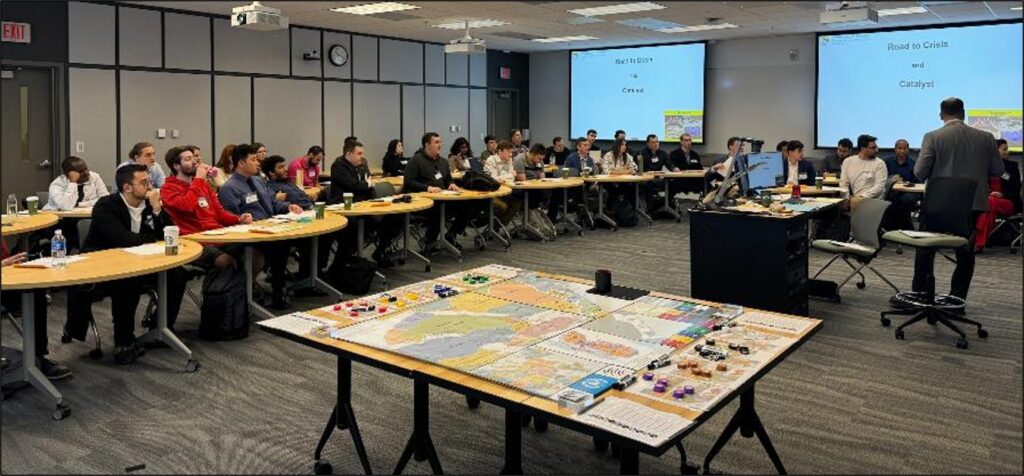
SGP functions as an interdisciplinary hub for experimental policy analysis at George Mason University. Branching from the Center for Security Policy Studies (CSPS), SGP integrates across the University’s specialized academic units to facilitate a multifaceted approach to the research and study of conflict and stability. Partnering organizations include:
- The Michael V. Hayden Center for Intelligence, Policy, and International Security
- The National Security Institute at the Scalia Law School
- Patriot Labs
- Center for Energy Science and Policy
- The Corruption, Networks, and Transnational Crime Research Center (CONTRA)
By integrating these distinct entities, SGP moves beyond the siloed study of security to construct a “living lab” where participants engage directly with the decision-making architecture that underpins global stability.
Aims
SGP’s primary objective is to subject theoretical concepts (for example, deterrence, escalation management, alliance durability) to strategic stressors for the purposes of exploratory analysis and education. The current international order faces concurrent shocks: a volatile transition to multipolarity, the rapid development and proliferation of emergent and disruptive technology, the weaponization of economic interdependence, and the diffusion of populist politics that challenge democratic consensus. Simultaneously, the accelerating friction of climate change and a resurgence of interstate conflict have exposed the fragility of peace.
Traditional analysis often assumes rational actors and perfect information. SGP’s aim is to model the friction, bureaucratic confusion, and human error that actually drive crises. Strategic games demonstrate that stability is not a passive state but an active, complex maintenance project requiring considerable investment to prevent fracturing. By simulating the collapse of these systems, participants identify the specific investments required to sustain or rebuild them.
For Schar School students—many of whom proceed directly to service in national security, foreign policy, critical domestic agencies, and international organizations—this experiential learning is critical. It bridges the gap between abstract seminar discussion and the “Situation Room”. By forcing them to grapple with imperfect information and rapid decision cycles, SGP supports graduates who possess the “muscle memory” and emotional resilience required for high-stakes public service.

Methods
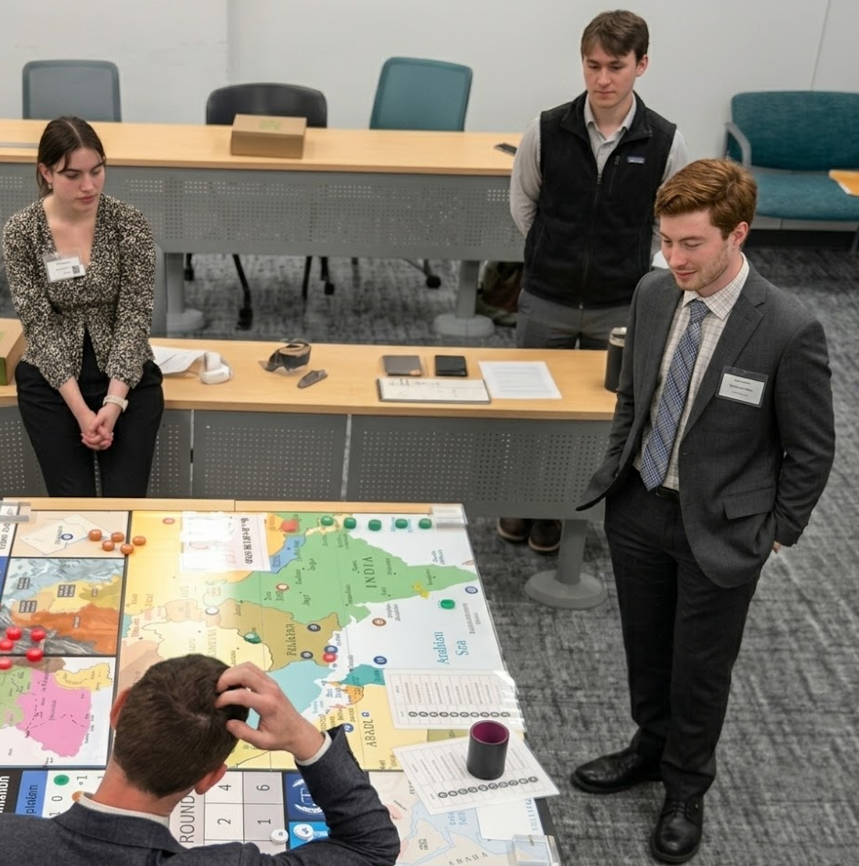
SGP’s remit is wider than wargaming. This means both taking an adaptive approach to gaming methods and topics as well as rejecting the view of the exercise as a standalone event. SGP applies a “Cycle of Research” methodology where simulations generate hypotheses, traditional analysis validates data, and exercises test execution. This iterative loop ensures that the products of the Center are not merely experiential; they yield executable insights and policy recommendations to promote deterrence stability, security resilience, and vulnerability insight at international, national, and sub-national levels.
Central to SGP’s approach is the concept of the “safe-to-fail” environment. Thomas Schelling famously posited that analysis without practicum cannot predict “unknown unknowns”. This discovery function is as vital for seasoned policymakers and government institutions as it is for students. It allows current leaders to stress-test alliances and escalation ladders without real-world consequences. The Center’s proximity to Washington allows these insights to flow directly into government and even international consultation, while simultaneously enriching our education of the future national security and foreign policy workforce.
Can strategic gaming support your analysis, education, or training goals? Submit a request!