Summary
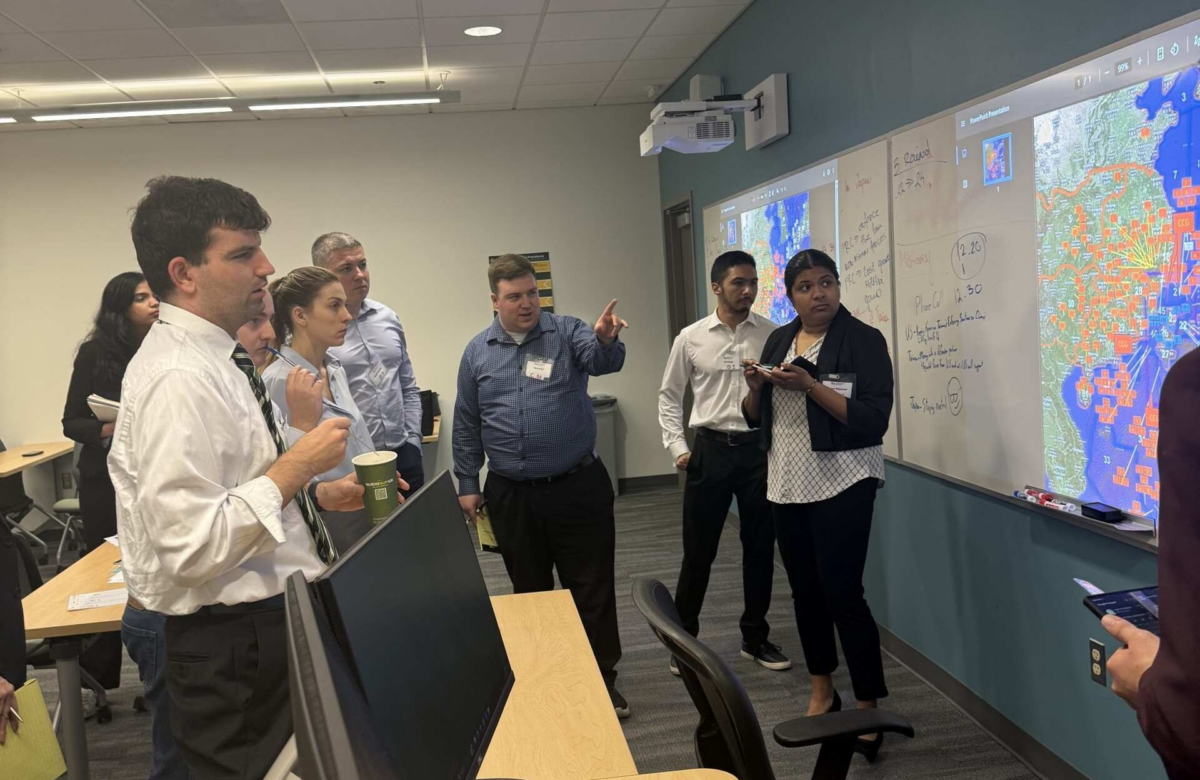
The 2026 Crisis: Taiwan simulation was designed to model a theoretical Chinese assault on Taiwan, beginning with a ‘quarantine’ and escalating to a direct attack on the island. The players were broken into teams representing the diplomatic, military, and executive branches of Taiwan, Japan, and the United States. Another team, representing China, served as a red cell to simulate adversary decision-making. The simulation was both a teaching tool for graduate students and an opportunity to test escalatory dynamics in the region under the conditions of the “fog of war.”
Goals
The simulation served two distinct objectives. The primary goal was to allow Schar School graduate students to test the theories they had learned in the classroom within an active and dynamic environment, exposing them to the stresses faced by policymakers in crisis scenarios. Considering the audience of graduate students with a diverse mix of backgrounds and areas of specialization, we set out to establish as much realism as possible without excessive granularity.
Additionally, the exercise allowed us to observe a plausible adversary operational concept against an active counterforce. By subjecting a well-understood potential operation to Clausewitzian friction, we sought to identify “unknown unknowns”—factors that, by their nature, are generally overlooked in traditional academic analysis.
Design
For the 2026 Crisis: Taiwan simulation, we chose a situational awareness exercise format. This structure deliberately disperses information and creates strains in inter-team communication to replicate the “fog of war” experienced in a real crisis. Teams were kept physically separated in different rooms spread over two floors, creating a tangible strain on communication. To recreate the differing operating procedures of institutions and the difficulty experienced in interagency cooperation, each group had specific rules and formats for carrying out actions. These rules, which were clear to each team internally, were opaque to the other teams, further straining communication.
To maintain situational awareness on the facilitator side, we improved upon a custom backend system we had previously established in an earlier crisis simulation. This infrastructure, designed by Dr. Lee Roberts and Dr. Jerad Harper, is a less granular form of more traditional theater-wide wargames. Functionally, this system operated behind the institutional simulation. As a result, rather than acting as a traditional wargame focused primarily on testing strategic principles, the situational awareness exercise framework allowed us to test strategy as it interacts with political deliberation and the strains of interagency cooperation.
Outcomes
The simulation highlighted strains in the “hub and spokes” system of alliances in East Asia, where the United States maintains bilateral guarantees with each nation rather than a multilateral regional framework. This system, coupled with strategic ambiguity pertaining to Taiwan, grants freedom of action to decision-makers at the cost of greatly increasing uncertainty for all parties.
Both the United States and Japan have a vested interest in preventing a Chinese military takeover of Taiwan. Together, they form a powerful deterrent force and possess a practiced capacity for military cooperation. However, in a high-stakes crisis, mutual uncertainty about how the other will act creates a “stag hunt” scenario. Both sides face high costs if they move without the other, making communication essential to reach an optimal outcome. The situational awareness exercise format highlights this sometimes-overlooked dynamic, forcing students to balance the benefits of freedom of action against the costs of uncertainty between allies.
The unique factors faced by the military teams generated interesting insights. The military teams of Japan and the United States possessed a direct line of communication, allowing them to cooperate effectively. However, the executive branches possessed final authority and often made decisions based on a wider range of factors than just military necessity. The military teams frequently felt their attempts to achieve tactical success were hamstrung by the executives, effectively modeling real-life tensions between a military’s tactical needs and a political branch’s broader mandate.
The China team was able to test the underlying assumptions of widely considered strategies under adversarial conditions. They attempted to leverage the uncertainty among the Taiwan, U.S., and Japan teams, actively seeking to create friction regarding their commitments to armed defense. Yet, they also struggled with uncertainty over how the United States and Japan teams would respond to escalatory behavior. Overconfidence that Japan and the United States would back down in the face of provocation led to increasingly escalatory behavior from China, which eventually triggered significant retaliation and an escalation cycle that China would have preferred to avoid.
In all, the 2026 Crisis: Taiwan simulation demonstrated to both students and researchers the effects of uncertainty on escalation. Uncertainty regarding ally resolve promoted overly cautious moves from the Japan and U.S. teams, which signaled weakness. In turn, attempts to exploit that perceived weakness by the China team led to escalation far beyond what they had initially desired.